Preorder Taking Manhattan
“We know who is going to wind up with the island in 1664 … but in ‘Taking Manhattan,’ Russell Shorto tells the story beautifully, and makes a compelling case for its enduring importance.”
— New York Times Book Review
“vivid history”
“masterful and irresistible”
“brisk and fact-filled… a story rich in intrigue, diplomacy and personalities.”
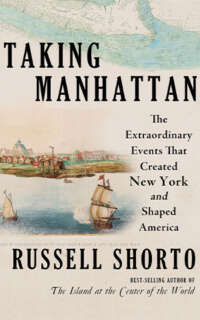
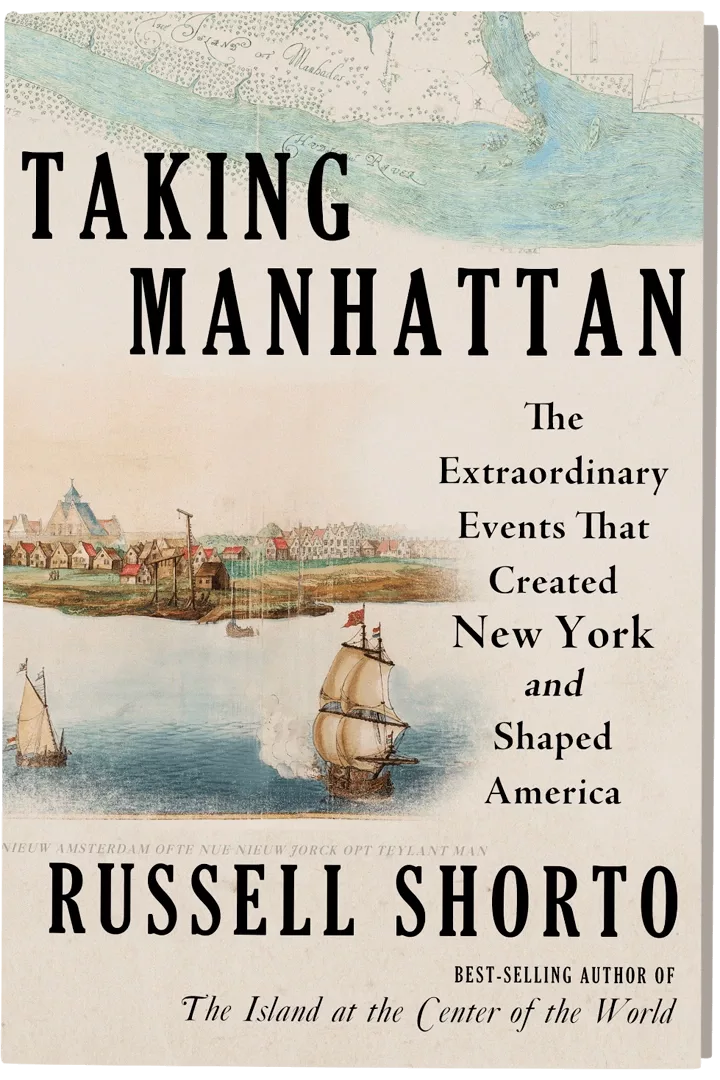
Why is New York the archetypal modern city – brash, bold, pulsing with energy? The author of The Island at the Center of the World offers up a thrilling narrative of how New York came to be.
In 1664, England decided to invade the Dutch-controlled city of New Amsterdam on Manhattan Island. Charles II and his brother, the Duke of York, had dreams of empire, and their archrivals, the Dutch, were in the way. But Richard Nicolls, the military officer who led the English flotilla bent on destruction, changed his strategy once he encountered Peter Stuyvesant, New Netherland’s canny director general.
Bristling with vibrant characters, Taking Manhattan reveals the founding of New York to be an invention, the result of creative negotiations that would blend the multiethnic, capitalistic society of New Amsterdam with the power of the rising English empire. But the birth of what might be termed the first modern city is also a story of the brutal dispossession of Native Americans and of the roots of American slavery. The book draws from newly translated materials and illuminates neglected histories — of religious refugees, Indigenous tribes, and free and enslaved Africans.
Taking Manhattan tells the riveting story of the birth of New York City as a center of capitalism and pluralism, a foundation from which America would rise. It also shows how the paradox of New York’s origins — boundless opportunity coupled with subjugation and displacement — reflects America’s promise and failure to this day. Russell Shorto, whose work has been described as “astonishing” (New York Times) and “literary alchemy” (Chicago Tribune), has once again mined archival sources to offer a vibrant tale and a fresh and trenchant argument about American beginnings.
“…fascinating history of a unique city… a book showing how New Amsterdam became New York”
“Russell Shorto’s new book is an engaging history of England’s takeover of New York from the Dutch in 1664. Shorto argues that…the city would remain more Dutch than English. This is a provocative claim, as the author admits, but it’s one he defends with polemical zest.”
“Bestselling historian Russell Shorto tells the fascinating story of the Dutch’s handover of Manhattan Island to the English in 1664. His vivid account emphasizes New York’s roots in pluralism and a capitalist ethos while also tracing the roles of slavery and the dispossession of Native Americans in the city’s founding.”
“Readers who loved Russell Shorto’s 2004 work of popular history, The Island at the Center of the World, will naturally want a sequel in equal measure to dreading a sequel. What are the chances, they might rightfully ask, that the same author could write on the same subject in the same way with the same winning combination of solid research and intense readability? [Taking Manhattan] works just as well as its beloved predecessor… There’s an appealingly broad cast of characters… and Shorto narrates it all in equal parts well-placed color commentary and periodic pauses for breath.”
“New York has two parents, Shorto insists… The city was born from the rivalry of two countries, which ultimately resulted in the creation of the first modern world city.”
“A riveting account of the men and women of Indigenous, Dutch, African, Jewish, and English descent who populated this thriving seventeenth-century port. Filled with new knowledge, eloquent prose, and international intrigue, Russell Shorto’s history will take your breath away.”
“A masterful account of the international struggle for control of 17th-century Manhattan…. packed with intrigue and fascinating subplots …. A bracing narrative of the international standoff that birthed America’s biggest city.”
“Shorto seamlessly weaves together secondary literature with newly translated Dutch documents to astonishing effect. This narrative is the historiographical Rosetta Stone of how New York City was born. With keen exactitude, Shorto explains how the Atlantic Slave Trade was an essential component of the building of New York City. As both a work of American and European history Taking Manhattan soars!”
“New Amsterdam — pluralistic, capitalistic, pulsing with energy — has survived. Best of all, Shorto himself feels everywhere present in these spirited, revelatory pages.”
“In this fascinating book, Russell Shorto unravels the DNA inside New York. I think I know New York, but it opened my eyes to the city and its rich history.”
Taking Manhattan picks up where The Island at the Center of the World leaves off. Shorto’s masterful narrative brings the much-neglected stories of Native Americans and African Americans into a heady stew that is our real founding story.